Why Traditional SEO Is No Longer Enough for Brand Visibility
SEO alone won't make your brand visible in 2025. Learn why AI search has changed everything for CMOs and how GEO is the missing layer in your marketing strategy.
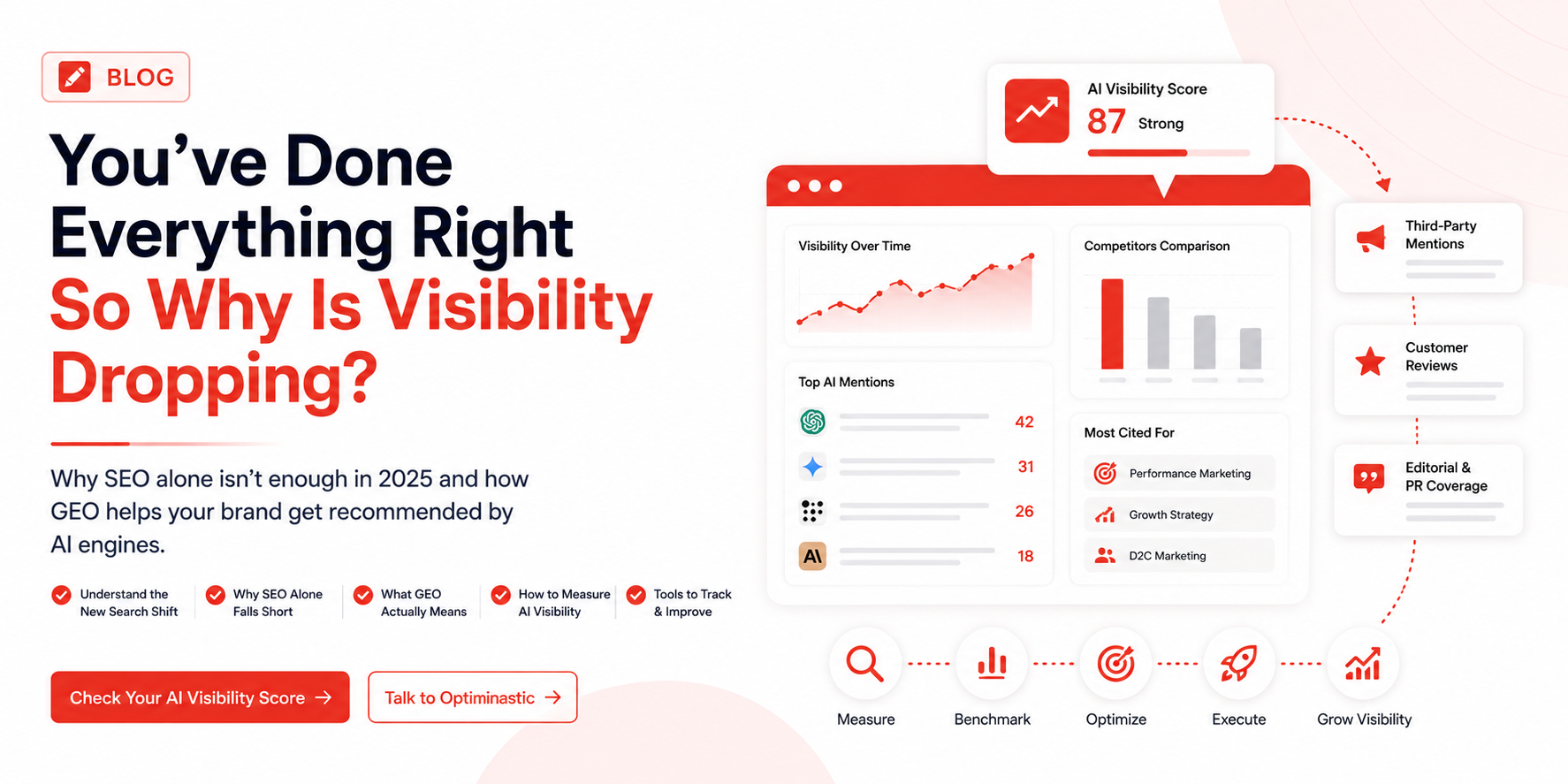
You've Done Everything Right So Why Is Visibility Dropping?
Your website ranks on page one. Your content calendar is consistent. Your backlink profile is healthy. Your SEO agency sends a monthly report full of green numbers.
And yet something feels off.
Leads from organic search are quieter than they used to be. Customers mention they "heard about you from ChatGPT" or "found you on Perplexity" but you have no data on that. And when you personally ask an AI assistant for a recommendation in your own category, your brand doesn't come up.
You're not imagining it. Something has genuinely changed and traditional SEO, on its own, can no longer keep up with it.
Phase 1 What Traditional SEO Was Built to Do
To understand why SEO is no longer enough, it helps to be clear about what it was designed for in the first place.
Traditional SEO was built around one core idea: help Google understand your content so it ranks your pages higher than your competitors' pages in its search results.
It works by optimising signals that Google's algorithm uses to evaluate relevance and authority keywords, backlinks, page speed, structured data, content depth, and more. When done well, it puts your website on page one for searches your target audience is making.
For nearly two decades, this was the primary lever for organic brand visibility online. Rank higher, get more clicks, drive more traffic, generate more leads. The logic was clean and the results were measurable.
And it still works for traditional Google search. That part hasn't changed.
What has changed is that traditional Google search is no longer the only place or even the first place where your customers are looking for answers.
Phase 2 How People Are Actually Searching in 2025
Think about your own behaviour over the last six months.
How many times have you typed a question into ChatGPT instead of Google? How often have you asked Gemini to summarise something, or used Perplexity to research a topic before making a decision?
Your customers are doing the same thing at scale.
AI-powered answer engines are now handling millions of queries every single day. People are asking them things like:
"Which digital marketing agency should I hire for my D2C brand?" "What's the best tool to track brand visibility online?" "Who are the top performance marketing companies in India?"
These are not niche technical queries. These are exactly the kinds of questions your prospective customers are asking and they are increasingly asking them to AI assistants, not search engines.
Here is the critical difference: when someone searches Google, they see a list of ten links and choose which one to click. When someone asks an AI assistant, they receive a single synthesised answer. The AI either mentions your brand or it doesn't. There is no page two. There is no "almost made it."
If your brand isn't in the answer, you don't exist for that customer in that moment.
Phase 3 Why SEO Alone Doesn't Solve This
This is the part that catches most marketing teams off guard.
Strong SEO does not automatically translate into strong AI visibility. The two are related but they are driven by different signals and measured in entirely different ways.
Google ranks pages. AI models recommend brands.
Google looks at your website's technical health, keyword relevance, and backlink authority. AI models look at your brand's overall footprint how often it's mentioned in credible sources, what context surrounds those mentions, how consistently it's described across the web, and what sentiment and specificity accompanies those references.
A brand can rank number one on Google for its target keywords and still be almost invisible in AI-generated answers. We see this regularly. The SEO is solid. The AI visibility is nearly zero. And because the team has been focused entirely on the SEO dashboard, nobody even knew.
The reverse is also true. Brands that have invested in editorial coverage, thought leadership, authentic third-party reviews, and strong PR even without exceptional technical SEO often have significantly better AI visibility. Because those are the signals AI models actually learn from.
SEO optimises for algorithms that rank pages. GEO Generative Engine Optimisation optimises for AI models that recommend brands.
They are different disciplines. In 2025, you need both.
Phase 4
What GEO Actually Means for Your Marketing Strategy
GEO is not a replacement for SEO. Think of it as the next layer the visibility strategy for the AI search era that sits alongside your existing efforts.
In practical terms, building GEO means focusing on the signals that AI models actually use when deciding which brands to reference:
Authoritative third-party mentions. AI models learn from credible, well-written content across the web. Press coverage in respected publications, mentions in industry articles, and references in expert content all carry significant weight. Digital PR is not just a brand awareness play anymore it is a GEO signal.
Specific, outcome-based content. Vague content ("we are a leading marketing agency") adds noise. Specific, results-driven content ("we reduced a client's CAC by 40% in 90 days using a three-phase brand trust framework") is the kind of language AI models pick up, retain, and reference.
Consistent positioning across every platform. If your website, LinkedIn, case studies, media coverage, and partner pages all describe your brand differently, AI models get a confused picture of who you are. Consistency of message is a GEO fundamental.
Volume and quality of customer reviews. Reviews across Google, industry platforms, and community forums are among the most trusted signals AI models reference when characterising a brand. Specific, detailed, positive reviews compound your GEO standing in ways that generic testimonials don't.
Cross-platform brand presence. The more places your brand is discussed authentically, not just on your own channels the stronger your AI footprint becomes.
Phase 5 How Do You Know Where You Stand?
Here is the practical challenge that most marketing teams face: you can't improve AI visibility if you can't measure it.
You can check your Google rankings every day with dozens of tools. But how do you know how visible your brand is to ChatGPT? To Gemini? To Perplexity? To Claude?
Until recently, the honest answer was: you couldn't. You could manually ask AI assistants questions and note what came back but that is not a measurement system. It's guesswork.
That is exactly the gap that Signalor AI was built to close.
Signalor AI is a brand visibility platform that tracks how the major AI engines ChatGPT, Gemini, Perplexity, and Claude currently see, cite, and recommend your brand. It gives marketing teams and CMOs a clear, trackable score for AI visibility alongside the competitive benchmarking and actionable recommendations needed to improve it.
For the first time, you can answer these questions with actual data:
- How visible is my brand in AI-generated answers right now?
- Which categories and queries am I appearing in and which am I missing?
- How does my AI visibility compare to my key competitors?
- What specific changes will move my score most efficiently?
Think of it as adding a new row to your marketing dashboard one that tracks the visibility channel that is growing fastest and currently has no measurement in most organisations.
The Bottom Line for Marketing Leaders
SEO is not dead. It remains a critical foundation for digital visibility and will continue to drive meaningful traffic for years to come.
But it is no longer sufficient on its own. A brand that is optimising only for traditional search rankings is optimising for yesterday's visibility landscape and leaving a growing share of prospective customers unaddressed.
The marketing leaders who will be ahead of this curve are the ones who start measuring AI visibility now, understand what drives it, and build GEO into their overall brand strategy before it becomes the urgent priority it will eventually be for everyone.
The discipline is still early. The tools now exist. The window to build meaningful AI authority in your category before your competitors do is still open.
The first step is knowing where you stand.