What Is a GEO Score? A Beginner's Guide to Your AI Visibility Number
A GEO score tells you how likely AI tools like ChatGPT and Perplexity are to mention your brand. Learn what it measures, what a good score looks like, and how to improve yours.
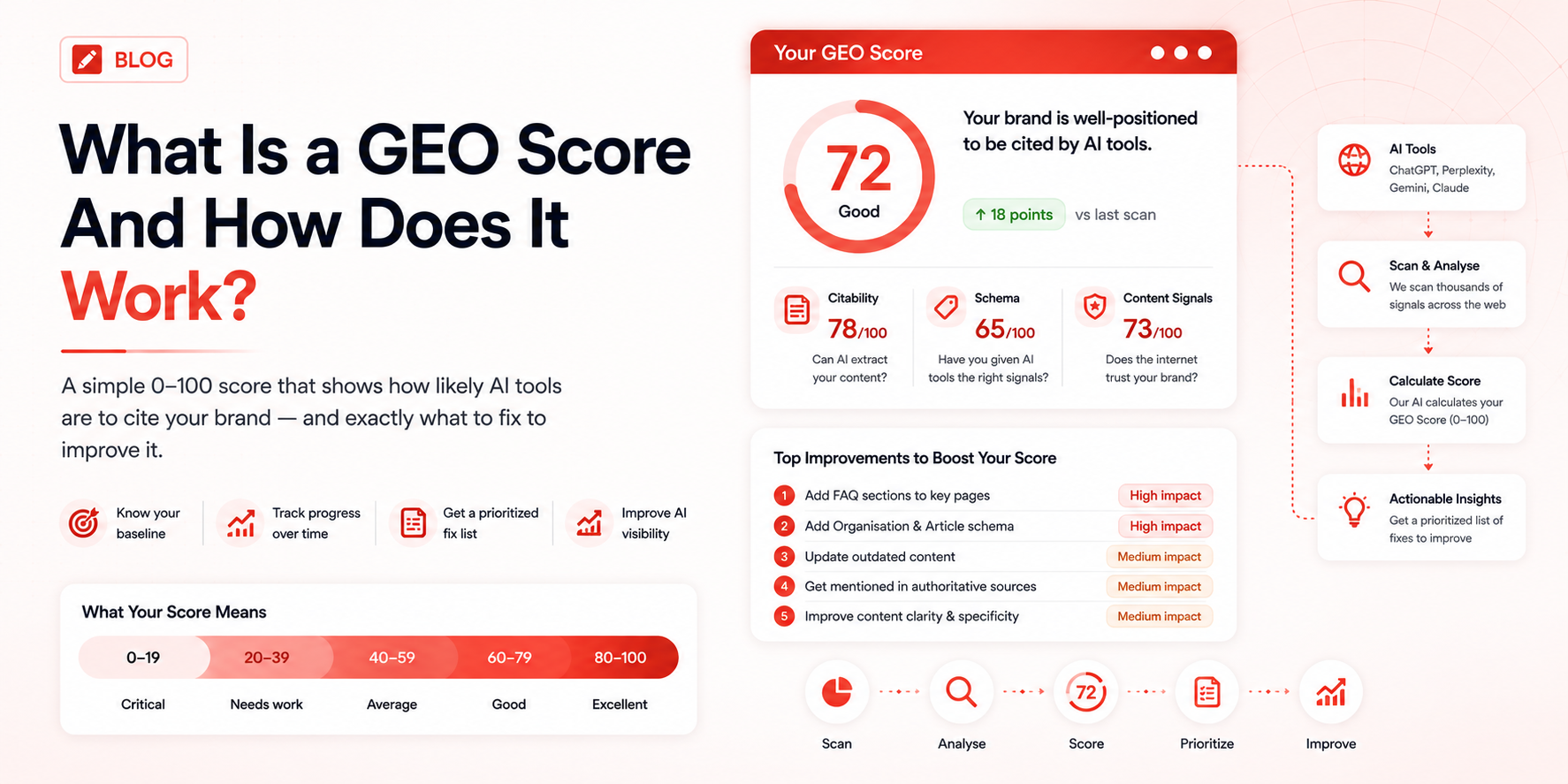
If you've ever used a credit score, you already understand the basic idea behind a GEO score.
A credit score takes a bunch of complicated financial signals your payment history, how much debt you have, how long you've had accounts and turns them into one simple number. Lenders look at that number and instantly know how trustworthy you are.
A GEO score does the same thing, but for your AI search visibility. It looks at your website, your content, and your online presence and gives you a single 0 to 100 score that tells you how likely AI tools like ChatGPT, Perplexity, and Gemini are to cite your brand in their answers.
The higher your score, the more likely you are to show up when someone asks an AI tool a question your business should be answering.
Why Does This Number Matter?
Before GEO scores existed, businesses had no easy way to know how they were doing in AI search. You could check your Google rankings. You could check your website traffic. But "are we showing up in ChatGPT?" had no clean answer.
You'd have to manually ask ChatGPT question after question and hope your brand came up. That's slow, inconsistent, and doesn't tell you why you're not showing up or what to fix.
A GEO score changes that. It gives you:
- A clear baseline you know where you stand today
- A direction higher is better, just like SEO rankings
- A list of fixes the score tells you exactly what's dragging it down and what to improve first
Think of it as a health check for your AI visibility.
What Goes Into a GEO Score?
A GEO score is made up of three things. Let's go through each one in plain language.
1. Citability "Can AI tools actually use your content?"
This is the biggest part of the score.
When an AI tool like ChatGPT is building an answer, it scans web pages looking for clear, usable information. It doesn't have time to read your whole website — it's looking for specific chunks of text it can pull into its answer.
Pages that score well on citability tend to:
- Answer questions directly and quickly (don't make the AI hunt for the answer)
- Use clear headings that describe what each section is about
- Have short, punchy paragraphs rather than dense walls of text
- Include FAQ sections, bullet points, and summary boxes
- Say specific things rather than vague things ("helps teams of 5–20 people" is more citable than "helps businesses of all sizes")
If your pages are full of marketing buzzwords and vague claims, your citability score will be low. AI tools simply can't extract useful information from them.
2. Schema "Have you given AI tools the extra signals they need?"
This one sounds technical, but the idea is simple.
Schema is a way of adding extra labels to your website that tell AI tools exactly what things are. Think of it like adding tags to a photo so a search engine knows who's in it, where it was taken, and when.
For example:
- An Organisation schema tells AI tools who your company is, what you do, and links your website to your LinkedIn profile, Wikipedia page (if you have one), and other trusted places that mention you
- A FAQ schema packages up your question-and-answer content in a special format that AI tools find very easy to read and cite
- An Article schema tells AI tools when your content was last updated, who wrote it, and what it's about
Pages with good schema are like pages with a clear label on them. AI tools know what they're getting before they even start reading.
You don't need to understand the technical details Signalor checks this for you and tells you exactly which schema is missing and how much it would improve your score.
3. Content Signals "Does the internet trust you?"
This third part looks at the bigger picture: how trustworthy does your brand look to AI tools based on everything that's out there about you?
AI tools don't just look at your website. They also look at what other people on the internet are saying about you. This includes:
Freshness Is your content recent? AI tools strongly prefer up-to-date information. A page last updated in 2022 scores lower than the same page updated this month.
External mentions Are other websites talking about you? Being mentioned in industry blogs, news articles, review sites like Trustpilot or G2, and business directories all boost this part of your score. Interestingly, AI tools are more likely to cite you if other trusted websites have mentioned you than if you just write about yourself.
Consistency Does your business appear consistently across the internet? Same name, same description, same details on your website, your LinkedIn, directories, and review sites. Inconsistency confuses AI tools.
Authority signals Are the people writing your content credible? Do they have author profiles? Are they quoted elsewhere? AI tools look for evidence that real experts are behind the information.
What Does a GEO Score Actually Look Like?
Here's a rough guide to what different scores mean:
Score
What It Means
80–100
Excellent you're well-positioned to be cited by AI tools regularly
60–79
Good you're showing up sometimes, but there are clear wins available
40–59
Average you're likely getting cited occasionally but missing a lot of opportunities
20–39
Needs work significant gaps in structure, schema, or trust signals
0–19
Critical AI tools struggle to understand or trust your content
Most businesses starting out with GEO land somewhere between 30 and 55. The good news is that even small improvements to the lowest-scoring area can move your number meaningfully and start getting you cited more quickly.
How Is a GEO Score Different From an SEO Score?
Great question, because they sound similar.
An SEO score measures how well your site is set up to rank in Google's list of search results. It looks at things like keywords, page speed, backlinks, and mobile-friendliness.
A GEO score measures how well your site is set up to be cited by AI tools. It looks at things like content clarity, schema, freshness, and external trust signals.
They're related but not the same. You can have a strong SEO score and a weak GEO score which is exactly what's happening to a lot of businesses right now who rank well on Google but are invisible in ChatGPT.
How Do You Improve Your GEO Score?
The score isn't just a number it comes with a prioritised list of things to fix, ordered by impact. The most common improvements are:
- Rewriting key pages to be clearer and more direct (improves citability)
- Adding FAQ sections to pages that answer common questions (improves citability + schema)
- Adding Organisation and Article schema to your site (improves schema score)
- Updating old content with fresh data and examples (improves content signals)
- Getting mentioned in external publications or directories (improves content signals)
You don't have to do everything at once. Start with the highest-impact fix and work down the list.
Quick Recap
- A GEO score is a 0–100 number that tells you how likely AI tools are to cite your brand
- It's made up of three parts: citability (can AI extract your content), schema (have you added helpful labels), and content signals (does the internet trust you)
- Higher is better most businesses start between 30 and 55
- It's different from an SEO score, which measures Google rankings
- The score comes with a prioritised list of fixes so you know exactly where to start