What Is Domain Rating (DR)? The Complete Guide for 2026
What Is Domain Rating (DR)? The Complete Guide to Checking & Improving Website Authority Meta Description: Domain Rating (DR) is a 0–100 score measuring how authoritative a website's backlink profile is. Learn how DR is calculated, why it matters for SEO and AI search, and how to check yours free on Signalor.
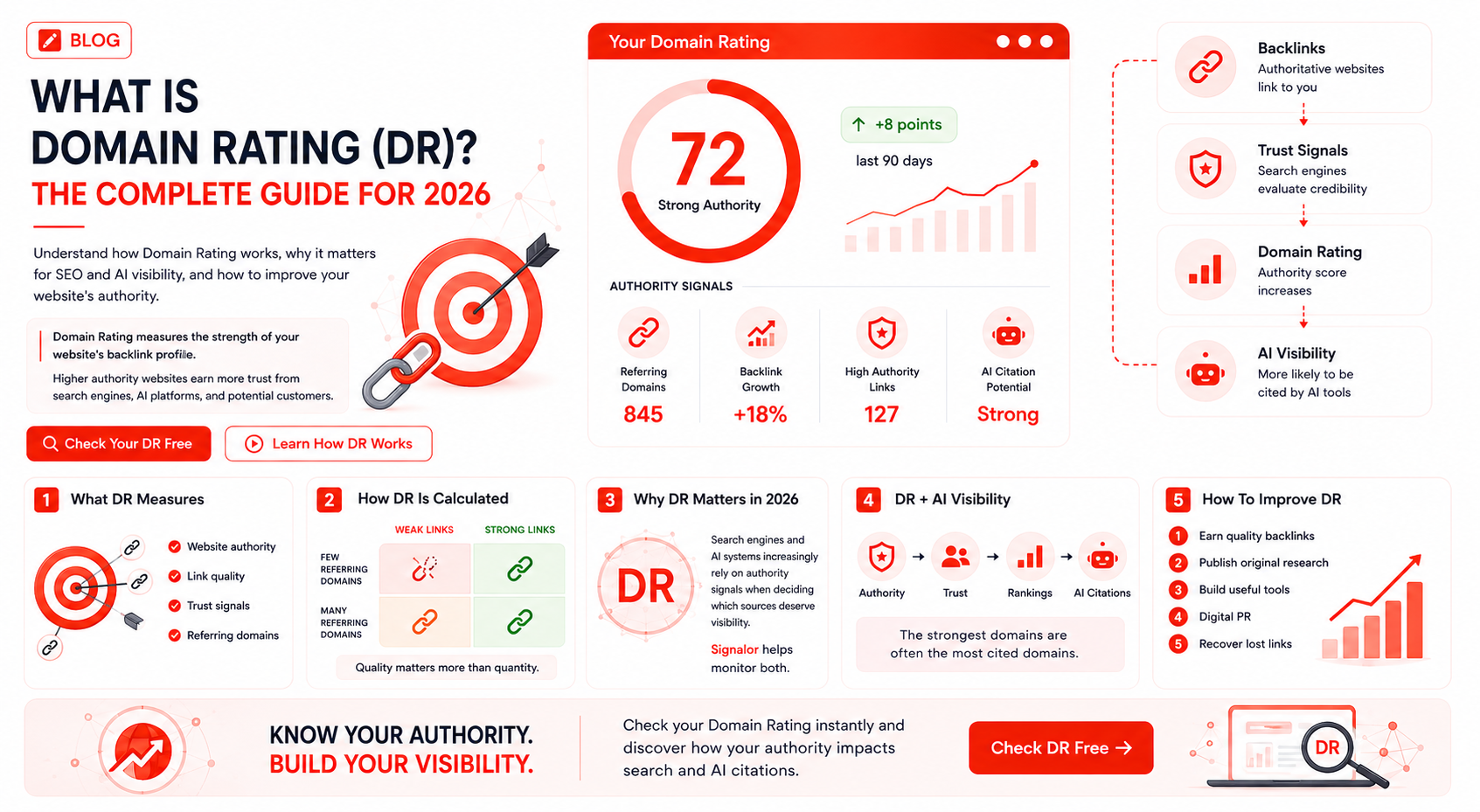
What Is Domain Rating (DR)? The Complete Guide for 2026
Domain Rating is one of the most talked-about metrics in SEO yet most site owners check it once, nod, and move on without really understanding what drives it, why it stalls, or how AI search engines use it. This guide covers all of that, plus how to check yours for free in seconds.
What Is Domain Rating (DR)?
Domain Rating (DR) is a 0–100 logarithmic score that measures the authority of a website's entire backlink profile. Developed by Ahrefs, it answers one core question: how strong and credible are the sites linking to this domain?
The higher the DR of the sites pointing to you, the higher your own DR climbs. It's a signal of trust earned through the web's link graph not something you can buy or game easily.
Unlike PageRank, which scores individual URLs, DR evaluates the domain as a whole. It's the off-page equivalent of a reputation score for your entire website.
How Is Domain Rating Calculated?
Ahrefs calculates DR by analyzing every domain that links to a target site, specifically looking at the DR of those linking domains and how many unique sites they themselves link to. Authority flows across the web in proportion to quality.
Three principles drive the calculation:
Quality over quantity. One link from a DR 80 publication moves your score more than 200 links from DR 5 directories. The caliber of who vouches for you matters far more than how many times you're mentioned.
Referring domain diversity. DR weighs unique linking domains, not raw link count. Ten links from ten different authoritative sites carry far more weight than ten links from the same domain.
Logarithmic compression. The scale is non-linear by design. Moving from DR 20 to DR 40 is considerably more achievable than moving from DR 70 to DR 80. Every point at the top requires exponentially more high-authority links.
Why Domain Rating Matters for SEO and AI Visibility
DR is not just a vanity metric. It correlates strongly with organic search performance and, increasingly, with how often AI answer engines cite your brand.
Search engine trust. Google doesn't use DR directly it's a third-party metric but DR is a reliable proxy for the off-page signals Google does weigh: the quality of your incoming links, the diversity of linking root domains, and topical relevance from those links. A rising DR typically reflects a backlink profile that search engines reward.
AI engine citation authority. Generative AI tools like ChatGPT, Perplexity, Google Gemini, and Claude pull answers from sources they deem trustworthy. Domain authority the real concept behind DR directly shapes which websites these AI engines choose to cite. A high DR signals that credible sources around the web already trust your domain, making it a more likely citation candidate when users ask relevant questions.
On Signalor, you can track your AI citation share across these engines alongside your domain authority signals connecting off-page SEO directly to AI visibility in one place.
Competitive benchmarking. DR gives you a measurable gap to close. If competitors in your niche cluster around DR 55–65 and your domain sits at DR 30, that gap often explains ranking differences even when your content is just as good. Knowing the gap is the first step to closing it.
Domain Rating vs Domain Authority: What's the Difference?
Both metrics score a domain's link authority on a 0–100 scale, but they come from competing platforms with different backlink databases and algorithms.
- Metric
- Created By
- Key Strength
- Domain Rating (DR)
- Ahrefs
- Largest backlink crawler in the industry; live data
- Domain Authority (DA)
- Moz
- Pioneered the category; widely used in legacy workflows
- Authority Score (AS)
- Semrush
- Blends link signals with organic traffic data
None of these metrics is official Google doesn't publish a domain authority number. DR, DA, and AS are all third-party approximations of real link strength. The best practice is to pick one, track it consistently, and use it for comparisons within the same platform. Signalor's free DR checker is sourced live from Ahrefs' index, making it one of the most accurate snapshots available.
What Is a Good Domain Rating Score?
"Good" is always relative to your niche and your competitors. A DR 35 blog can outrank a DR 60 site on low-competition keywords with stronger on-page content. That said, here are practical benchmarks:
- DR 0–15: Brand-new or barely-linked domains. Most content will only rank for very low-competition searches.
- DR 16–29: Early-stage growth. Showing some link activity but the profile is still thin.
- DR 30–49: Competitive in many niches. A DR 40+ site with strong content can target mid-difficulty keywords effectively.
- DR 50–69: Strong authority. Typical of successful independent publishers, established agencies, and B2B brands with active content programs.
- DR 70–100: Elite. Major media outlets, university domains, government sites, and enterprise brands with years of consistent link acquisition.
The number that matters most isn't your absolute DR it's your DR relative to whoever ranks above you for your target keywords.
How to Check Your Domain Rating for Free
You can check any domain's DR instantly using Signalor's free Domain Rating checker. The tool pulls live data from Ahrefs' authority index with no account, no sign-up, and no usage limits.
Step 1: Go to signalor.ai/tools/domain-rating
Step 2: Enter the domain you want to check — your own site, a competitor, or a prospective link partner. No need to include https://.
Step 3: Get your DR score instantly. Results appear in seconds: a 0–100 Domain Rating sourced directly from Ahrefs' live backlink index.
Step 4 (optional): Sign up for Signalor to track your DR growth week-over-week, monitor new and lost referring domains, and benchmark against competitors automatically rather than checking manually each time.
The free checker gives you a point-in-time snapshot. Tracking gives you the trend, which is where the strategic insight actually lives.
How to Improve Your Domain Rating
DR is an output metric it reflects the health of your backlink acquisition strategy. To move it, you need to earn links from authoritative, relevant domains. Here are the highest-leverage ways to do that:
Publish original research. Proprietary data surveys, industry studies, unique datasets gives journalists and content teams a reason to cite you. A single well-distributed data study can attract hundreds of editorial links and continue earning passively long after publication.
Build genuinely useful tools and resources. Free tools, calculators, comprehensive guides, and interactive assets earn passive links because people bookmark and share them. Signalor's free URL analyzer and DR checker exist for exactly this reason: they create real value that naturally earns attention and links.
Invest in digital PR and media placements. One link from a DR 80+ publication moves your score more than dozens of directory submissions combined. Building relationships with journalists in your space and pitching data-led story angles is one of the most efficient DR acceleration strategies available.
Guest post on relevant, high-DR sites. Guest publishing on topically related, authoritative sites remains one of the most controllable link-building channels. Relevance is the key word links from unrelated domains carry less weight and can look manipulative at scale.
Reclaim lost and broken backlinks. A backlink audit often reveals referring domains that have removed or broken your link over time. Reaching out to restore these is one of the fastest DR wins because the relationship already exists.
Build topical depth on your own site. Search and AI engines increasingly reward topical authority domains that cover a subject comprehensively and consistently. Deep content clusters establish your domain as a trusted expert source, which supports both rankings and AI citation frequency over time.
Domain Rating in the Age of AI Search
The growth of AI-powered search has added a new layer to domain authority strategy. Tools like ChatGPT, Perplexity, Gemini, and Claude don't simply rank pages they synthesise information and attribute answers to specific sources. The sources they cite most are those with strong credibility signals: authoritative backlinks, topical expertise, and consistent trustworthiness across the web.
Domain Rating is one of those credibility signals. A high DR communicates to AI engines that respected publishers around the web already vouch for your domain, making your content a more likely citation candidate when users ask questions in your space.
This is why Signalor tracks your AI citation share across ChatGPT, Gemini, Claude, and Perplexity alongside traditional authority metrics. DR is the off-page foundation; AI citation share is the output that tells you whether that authority is actually translating into visibility where modern search is heading.
Frequently Asked Questions
What is a good Domain Rating score? Any DR above 40 is considered solid for most niches. DR 60+ puts you in a strong position, and DR 80+ is reserved for major publishers and enterprise brands. More important than the absolute number is how your DR compares to the sites ranking above you for your target keywords.
Is Domain Rating the same as Domain Authority? No. Domain Rating is created by Ahrefs; Domain Authority is created by Moz. Both use a 0–100 scale and measure link strength, but they rely on different backlink databases and algorithms, so the scores are not directly comparable.
How can I check my Domain Rating for free? Use Signalor's free Domain Rating checker at signalor.ai/tools/domain-rating. Enter any domain and get an instant DR score powered by Ahrefs' live index no account or sign-up required.
Does Google use Domain Rating as a ranking factor? Google doesn't use DR directly it's a third-party metric. However, DR is a strong proxy for the real backlink quality signals Google does factor in. A high DR typically reflects a link profile that aligns closely with what Google's algorithm rewards in off-page SEO.
How long does it take to improve Domain Rating? Consistent link building from authoritative domains can move your DR meaningfully within 3–6 months. Due to the logarithmic scale, early gains (DR 10 to 30) come faster than later ones (DR 60 to 70). Focus on quality and pace of acquisition DR reflects that work naturally over time.
Why isn't my DR updating after I got new backlinks? DR isn't updated in real time. Ahrefs recalculates scores periodically, so there's typically a lag of a few days to a few weeks between acquiring a link and seeing it reflected in your score. A single new link also rarely produces a visible change DR moves on the accumulation of quality links over time.
Check any domain's DR instantly free, no sign-up at signalor.ai/tools/domain-rating. Track growth over time and benchmark against competitors with a Signalor account.