What Is AI Search? How ChatGPT, Perplexity, and Gemini Actually Find Answers
Learn how ChatGPT, Perplexity, and Gemini actually find and cite sources when answering questions and what that means for your brand's visibility in AI search.
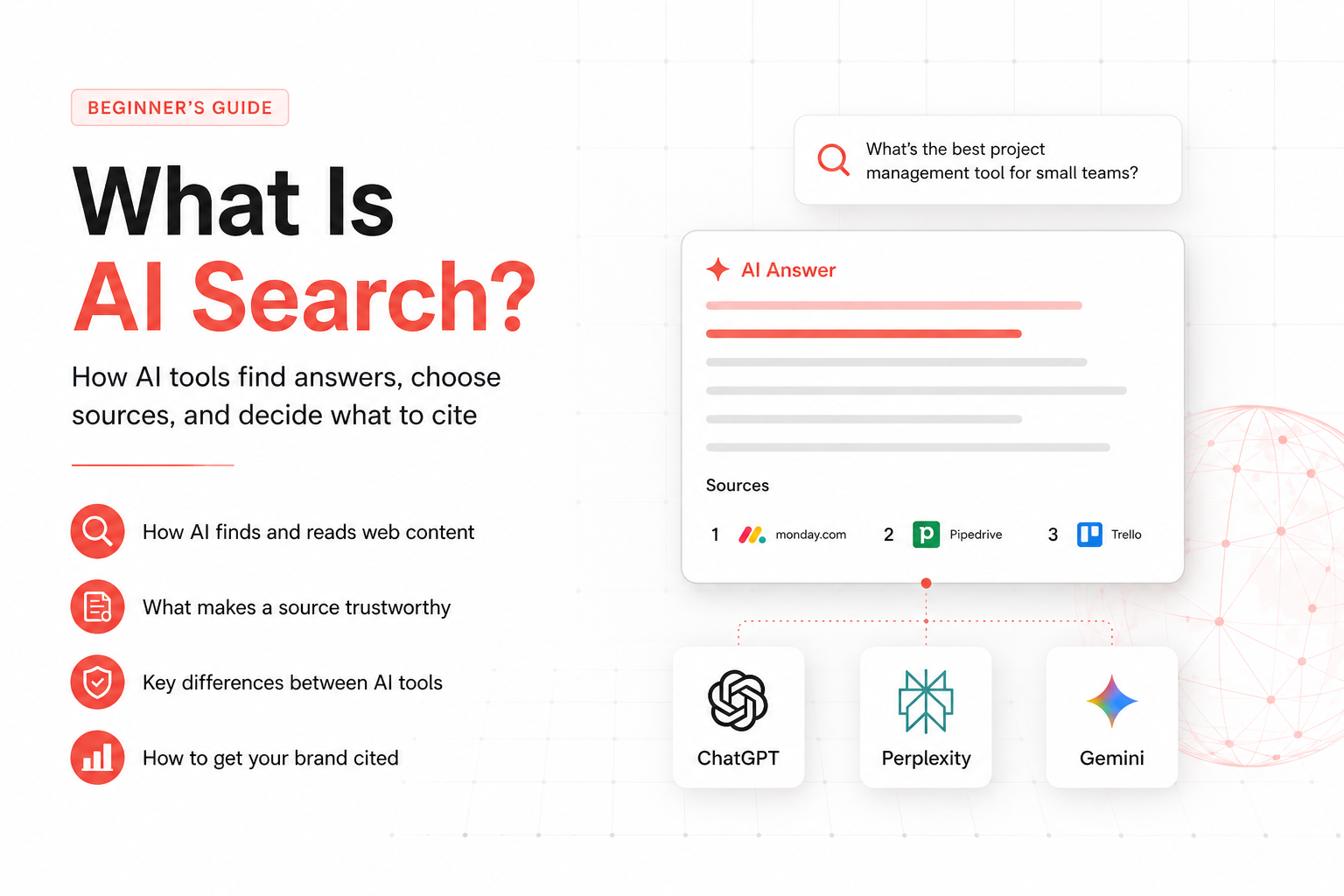
When you type a question into Google, you know what happens. Google shows you a list of links. You click one. You find your answer.
When you type the same question into ChatGPT or Perplexity, something very different happens. There's no list. There's just an answer written in plain language, sometimes with sources at the bottom.
But where did that answer come from? Which websites did the AI read? Why did it cite some sources and not others?
Understanding this is the foundation of everything in GEO. Let's break it down simply.
Two Very Different Systems
Google is a search engine. Its job is to index the web and return a ranked list of relevant pages. It doesn't write answers. It finds documents.
ChatGPT, Perplexity, and Gemini are AI answer engines. Their job is to understand your question and write a complete, helpful response. They can pull from live web content when needed but they don't just show you links. They synthesize.
This difference sounds simple. But it changes everything about how brands need to think about online visibility.
How Does an AI Tool Actually Answer a Question?
Here's a simplified version of what happens when you ask Perplexity "what's the best project management tool for small teams?":
Step 1: The AI searches the web Perplexity queries its search index (mostly Bing) for pages relevant to your question. It retrieves several candidate sources.
Step 2: The AI reads those pages It extracts relevant information from each page specifically looking for direct, clear answers to the question asked.
Step 3: The AI synthesizes an answer It combines information from the best sources into a single written response. It doesn't copy-paste it understands and rewrites in its own words.
Step 4: The AI cites its sources It adds citations at the bottom (or inline) linking back to the pages it drew from.
The pages that get cited are the ones the AI decided were the most relevant, clear, and trustworthy sources for that specific question.
The pages that don't get cited? They were either not found, not readable, not clear enough, or not trusted enough.
What Makes an AI Trust a Source?
This is the core question behind all of GEO. Here's what matters:
Clarity of the answer
If your page takes three paragraphs to get to the point, AI systems may skip you in favour of a page that answers directly in the first sentence. AI tools are extracting answers at speed. They reward pages that make extraction easy.
Structured data
Structured data (also called schema markup) is code on your page that tells AI systems what your brand is, what the page is about, and what claims are being made. It's like a label on a jar instead of AI guessing what's inside, you tell it directly. Pages with valid structured data are easier for AI to trust and cite correctly.
Brand recognition and consistency
AI tools have learned from vast amounts of web content. Brands that appear consistently across many trusted sources news articles, Wikipedia, industry directories, LinkedIn are already familiar to the AI. That familiarity increases citation confidence. A brand that only appears on its own website is less trusted than one that appears across the wider web.
Whether the AI crawler can read the page
Each AI tool has its own crawler that visits websites to read their content. If your site accidentally blocks these crawlers which happens more often than you'd think the AI literally cannot read your page and therefore cannot cite it.
How Are ChatGPT, Perplexity, and Gemini Different From Each Other?
They're all AI answer engines, but they work differently under the hood:
Perplexity is the most retrieval-focused. Almost every answer involves a live web search. It cites sources consistently and visibly. Being indexed on Bing (its main search source) is essential for Perplexity visibility.
ChatGPT blends its training knowledge with live web retrieval. It doesn't always search the web it will often answer from memory. When it does search, it uses Bing. ChatGPT tends to favour brands it already has strong entity knowledge about from its training data.
Gemini is Google's AI, and it pulls from Google's index rather than Bing. That makes traditional Google SEO signals (Google indexing, Google-accessible pages) more relevant for Gemini visibility than for the others.
Claude (Anthropic) is primarily a reasoning and generation tool, though it can use web search when enabled. It's increasingly being used in enterprise workflows where citations matter.
Each engine has its own retrieval logic. An optimized brand should be visible across all of them not just one.
Why This Matters for Your Brand
Here's the shift that most marketing teams haven't fully processed yet:
When someone asks an AI tool a question in your industry, there are two outcomes:
Your brand gets cited you get visibility, trust, and potentially a click
A competitor gets cited they get the visibility, and you get nothing
Unlike Google, where 10 results appear and users might scroll to find you, AI tools give one synthesized answer. The citation winner takes most of the value.
This isn't speculative. AI tool usage has grown dramatically and it's not slowing down. The question isn't whether AI search matters. It's whether your brand is showing up inside it.
What You Can Control
The good news: AI citation isn't random. There are specific, concrete signals that AI tools use to decide who to cite and those signals are improvable.
You can:
- Structure your content so AI tools can extract answers easily
- Add structured data that tells AI systems exactly what your brand is
- Make sure AI crawlers can access your website
- Build consistent brand presence across trusted third-party sources
- Track which prompts are citing you (and which are citing competitors)
This is exactly what GEO covers. And it starts with understanding what AI search actually is which you now do.
The Simple Version
AI search tools don't rank pages. They write answers and cite sources. Getting cited requires different signals than getting ranked on Google. The brands that understand this and optimize for it now are building a visibility advantage that compounds over time.
Want to see how often AI tools are currently citing your brand and for which questions? Try Signalor free →
Next in this series: What Is a GEO Score and How Is Your Site Performing Right Now?
Tags: what is AI search, how ChatGPT works, how Perplexity works, AI answer engines, AI citations, generative engine optimization, GEO beginners, AI visibility, ChatGPT vs Google